movies and comic books

A few short things today. If you haven't checked since a week ago, scroll down for two mid-week posts (a character meme, and some nice words about A Sane Woman).

1. In this post, I talked about the comic book storylines and characters that were being cut short for the big general reboot at DC Comics. Based on this article at the AV Club website I'm not the one one who thought that both Batgirl and Secret Six were pretty special.

Oh, and the resolution of "Scandal Savage’s love triangle with cosplaying stripper Liana and newly revived Female Fury Knockout"? She rescued one of them from Hell, and the other from a fundamentalist nutjob, and then, unable to choose between then (and having been reminded by one of her teammates that they are not heroes and don't have to play by the rules), she married both of them.

I suspect that polygamous lesbian marriages are only allowed in mainstream comics when 1) the characters are villains, and 2) the book has already been cancelled and all the continuity is about to be wiped out anyway.

2. I think Johnny Depp has finally managed to find a movie to star in which I will never see. A remake of The Thin Man? With possible musical numbers? (And, though this wasn't mentioned, I'm sure with considerably less alcoholism.) Ah, no thanks. Johnny, I like you a lot, but, sir, you are no William Powell, and your co-star, whoever she ends up being, is no Myrna Loy.

3. Jody Moller had an interesting post, and one comment she made has stuck with me: "Who are your favourite Authors? No doubt they are the ones you are aspiring to be like."

I'm not sure this is true, at least I don't think it's true for me. If I have a "favorite" writer, it's Thomas Pynchon, and I don't think I write like him, and I'm pretty sure I've never tried. But then I remembered the single biggest influence on my writing, which is Robert Altman. I guess I'm trying to be my favorite movie director instead.

And I'm not the only one. Magnolia was clearly P.T. Anderson's attempt at making his own Nashville, as I talked about here. And I just watched Michael Winterbottom's movie The Claim, and he was clearly making his own McCabe & Mrs. Miller.

It's a pretty good movie. It's no McCabe and Mrs. Miller (what is?), but it has a lot going for it. The biggest weakness is the actors. The main actresses (Sarah Polley, Nastassja Kinski and Milla Jovovich) are so strong that the lead actors, who are competent but not exceptional, just can't keep up.
drinking beer, in new york, in cellars

I'm getting a bit sick of Facebook. It's fun, but I've been feeling the need to read some online writing with a bit more depth, thoughtfulness, and (yes) length. Brevity may be the soul of wit, but wit does not, in and of itself, make for a really nourishing diet.

So, I started to poke around wordpress.com. There are millions of WordPress sites on the web, and over 300,000 of them are hosted at WordPress.com. I almost immediately found this post, which was pretty much about the reason I was there in the first place, the effect of lots of shallow skimming as opposed to "deep reading" (though that phrase itself makes me laugh, since it reminds me of "Deep Thoughts" by Jack Handey, and of course Deep Thought from The Hitchhikers Guide to the Galaxy).

And then, in the most surprising bit of serendipity, I went to the Tags page on wordpress.com and, since I had already read quite a few posts about writing, I clicked on "movies" instead. And I immediately found this, a very good review of California Split, an excellent movie by Robert Altman (which I never did get around to reviewing myself). As I said in my comment on that blog, I think I will just link to that review on my movie reviews page, since the author said pretty much everything I would have said, and more.

Plus, my friend Beth has started a very interesting blog here. It's about "all the influences you’ve been told will turn your teen violent: the occult, violent video games, heavy-metal music, and more."

Oh, and I don't know if it counts as "deep reading," but I've started to re-read The Bostonians, which I'm already enjoying tremendously. I can't get through The Golden Bowl or The Wings of the Dove, but many of his earlier novels (before he got his "typewriter") were excellent.

Basil Ransom, on the occasion of his first meeting with Olive Chancellor, his cousin:

He couldn't believe he was one of her kind; he was conscious of much Bohemianism—he drank beer, in New York, in cellars, knew no ladies, and was familiar with a "variety" actress. Certainly, as she knew him better, she would disapprove of him, though, of course, he would never mention the actress, nor even, if necessary, the beer.

lost my muchness, have i?

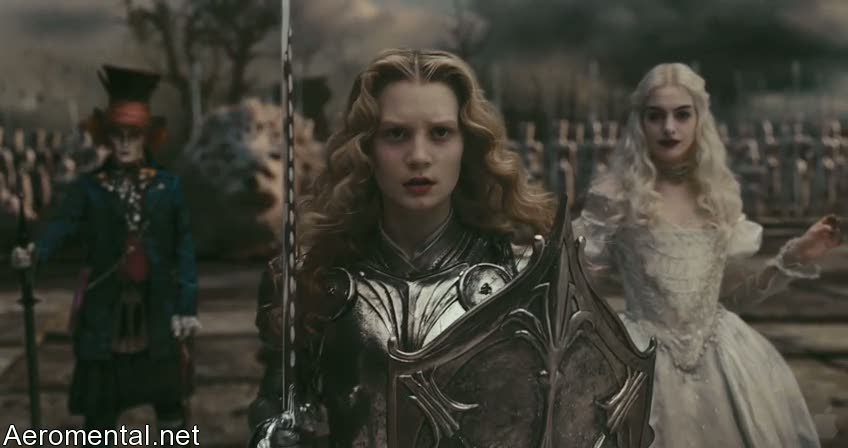
I just watched Alice in Wonderland, and I liked it a lot. I remember some of the reviews complained that it wasn't the regular Alice story, but that's why I liked it. Do we really need yet another version of the regular Alice story?

It is great to look at, of course (it is Tim Burton, after all). And, since it is Tim Burton, the forward momentum is a bit bumpy, but you expect that.

I saw it on DVD, so I can't comment on the 3D, which was one of those "We'll shoot it in 2D and then convert it to 3D later on" deals. To the experts, that's apparently pretty much like shooting a movie in black and white and then colorizing it later.

But the story is good, the contrasts between the regular world and "Underland" are pointed without being telegraphed, and the actors are wonderful, particularly Johnny Depp (who I always like) as the Mad Hatter and Helena Bonham-Carter (who I don't always like) as the Red Queen ("I need a pig here!"). Plus the voice actors, especially Stephen Fry as the Cheshire Cat and Alan Rickman as Absolem the blue caterpillar. The Jabberwocky has very few lines, but they're especially effective because the voice is Christopher Lee's.

I liked Mia Wasikowska as Alice. In a movie like this, being "the normal person" can be a pretty thankless task, and she's rather bland in the early parts. Some critics complained about this, but I think it's deliberate. Alice is not totally engaged for a long time, because she thinks this is all a dream and she'll wake up at some point. But then she realizes that it is real, and what she does will matter a whole lot.

Of course, the story does have the "Is she the real Alice?" thing (in other words, is she the one?), but even so she does what she does by going off of the path that's laid out for her, by doing what she thinks she should be doing.

And, unlike Roger Ebert, I liked the ending. After all, it's almost always a guy who ends up being the champion.

the bechdel test

To pass the Bechdel Test – named for Alison Bechdel, the wonderful writer and artist of Dykes to Watch Out For – a movie must meet three basic criteria:

  • It has to have at least two women in it
  • Who talk to each other
  • About something besides a man

This would seem like a fairly simple test to pass, but a lot of movies fail, as is detailed here.

Of course, passing the rule (or not) doesn't tell you whether it's a good movie, or even really indicate what the movie says about women, but it's striking how many movies fail the test.

For example: Avatar, The Social Network, Inception (there is some disagreement about that one), The Girl with the Dragon Tattoo (The Girl who Played with Fire is not listed, but it would pass), Inglourious Basterds (there's disagreement, but it's a fail), and Kick-Ass.

By the way, some movies which do pass the test are: Machete, all four "Resident Evil" movies, Watchmen (there's disagreement, but based on what I remember it's a pass), The Golden Compass, both "Kill Bill" movies, and both "Narnia" movies. The "Lord of the Rings" movies fail, of course. Three-fourths of the "Alien" movies pass.

Gone Baby Gone isn't listed, but I think it's a pass. The Town is apparently a fail. The "Lara Croft" movies are notable for not having any female characters at all other than Croft herself.

I read one review of Up in the Air that specifically mentioned the Bechdel test, saying how rare it was to see a movie that passed it.

Let Me In is apparently a fail, (Abby asking at the hospital desk which room her "father" is in doesn't count since the woman behind the desk is not a named character). Let the Right One In (the original) is more complicated. [spoilers follow]

show

As I say, this is just one aspect of a movie, not any sort of definitive judgment of its value. But it is striking how many of the movies which do pass manage to squeak by based on one short scene (sometimes only two lines of dialogue).

And it's not that difficult to have a lot of such scenes, and in a really great movie. Let me direct your attention to Gosford Park, for example.


More of "The Rock Band Mystery" is posted. The new parts begin here.

And the story does contain a few conversations between different female characters, about subjects other than men.

bite-sized chunks

As I mentioned here, I'm looking into the possibility of moving this site to Drupal Gardens, and I happened on another Drupal Gardens site, www.susanmacphee.com, where I saw this article, "A Beginner's Guide To Website Copywriting."

These points are fairly standard instructions for how to write copy for the web (even the New York Times allows a slightly more conversational and informal style on their blogs than they do in their actual articles), but some of them also apply to writing fiction for the web.

When I started A Sane Woman in the late 1980s, I published it in little chapbooks, one for each chapter. It was written for that format, and when I got online around 1990 I found that it didn't really work as a series of short BBS posts. So, I abandoned it (for a while) and started U-town, which was designed to work in short chunks of that size. This is pretty much true of everything I've done since, including the mystery stories I'm writing now.

Drawing the readers in is definitely a challenge (it's a thing that TV has to do much more than movies, for example, since it's a lot easier to flip to another channel than it is to walk out of a movie theater). When I first wrote U-town, the scene of Vicki on the bridge was in the middle. When I was rewriting, I moved it to the beginning, since it is much more intriguing (I hope) than the original beginning.

The "pyramid style" of newspaper writing (starting with "Who, What, Where, When, Why") doesn't mostly work for fiction, in my opinion. Telling a story is different from writing a newspaper article. When we see Vicki on that bridge, we know very little; and things are only revealed gradually throughout the book, including what "U-town" even is.

This applies very particularly in mystery stories, as talked about last time, but I think it's true of fiction pretty generally.


On another subject, I just watched the movie Laurel Canyon, and I thought the performances were good (and, in the case of Frances McDormand, great) but the story was frustrating.

My main complaint is that everything that happens in the movie is pre-programmed and unconvincing, but it doesn't pay off, since the ending is very ambiguous. You can have a loose, lived-in movie that has a low-key ending (Robert Altman did this a lot), or you can have a predetermined movie that leads up to something definitive and pleasing. But you can't have a pre-determined movie (where, as Roger Ebert says, we uneasily begin to sense the presence of the screenplay) that doesn't go anywhere. It's like getting to the end of Murder on the Orient Express and not finding out who did the murder, or removing the last fifteen minutes of His Girl Friday.

Also, the actual scenes of music recording are not convincing if you've ever been in a recording studio, and (as another critic pointed out) all the music they're making sucks. Someone from the record company keeps calling and complaining to McDormand's character that the album she's producing doesn't have a hit single. I'm sure the record company woman was supposed to represent Corporate Pressure on Artists (she usually calls while she's running on a treadmill), but if I was hearing the results of those sessions I'd be worried, too.

the big reveal

I've been thinking about the big reveal in stories. You know, like the Big Surprise in The Crying Game or The Sixth Sense. There are a few reasons this has been on my mind.

  • I just rewatched Fight Club, including listening to the commentary track by the director and stars,
  • I just read a story which had a big reveal, and
  • Of course, I'm writing mystery stories.

Mystery stories, by their nature, have a big reveal: the solution to the mystery. But I've never found that the mystery and its solution are the main reason I'm drawn to certain mystery series and writers. And, listening to the commentary track for Fight Club, it was pretty clear that the actors and director were far more interested in the reveal than I was.

For the actors, of course, it made sense, since they had to play the parts. But it wasn't what made the movie good, it wasn't why people quote it all the time, it wasn't why there's "Jane Austin's Fight Club" (google it immediately if you haven't seen it). And, if Fight Club was really just about guys beating each other up, why are the biggest FC fans I've known all young women? (Which is why the Jane Austin clip is so great.)

Why do I read and re-read the Nero Wolfe mysteries? Not because of the mysteries, though some of them are very good. But mostly to spend time with Wolfe and Archie and Fritz and Saul Panzer and Cramer and the gang.

On the other hand, though the mystery and the reveal are not the most important thing, you do have to handle them correctly. As I refer to here, one of the problems with The Girl with the Dragon Tattoo is that it is a good mystery, surprisingly classical in its construction, but it isn't handled correctly. When the solution to the mystery is revealed over one hundred pages before the end of the book, the rest of the book inevitably becomes a letdown.

Full disclosure: I knew the secret in The Sixth Sense before I saw the movie, from reading reviews. Movie critics like to hint when they know something you don't, and if you put enough hints together you can get to the fact. I still enjoyed the movie. I knew the secret in The Crying Game for the same reason most New Yorkers did – they did a survey when the movie came out, and (for some weird reason) people in New York weren't fooled. But it was still a good movie, and not only because it quotes, more than once, the story of the frog and the scorpion from Orson Welles' film Mr. Arkadin. And I had no interest in The Village at all until I read a spoiler online. I did enjoy the movie, unlike many people, and I never would have seen it if it hadn't known the "twist" ending.

With Fight Club I didn't have a clue.

Which brings us to spoilers, a topic I talked about here. The Time article I link to, the one that started me thinking about this, seems to have been removed (or at least the link now goes to a different, though related, article). I also had a link to an article on Slate about spoilers, and that seems to be gone completely. Conspiracy?

I also saw this article on the A. V. Club website: What really constitutes a spoiler?, which led me to this article, which talks about Cerebus, as I did here.

At least the A. V. Club leaves their articles online.